



Strategic vs Operational Procurement:
What’s the Difference and Why It Matters
Dan Solomon
4/25/20252 min read
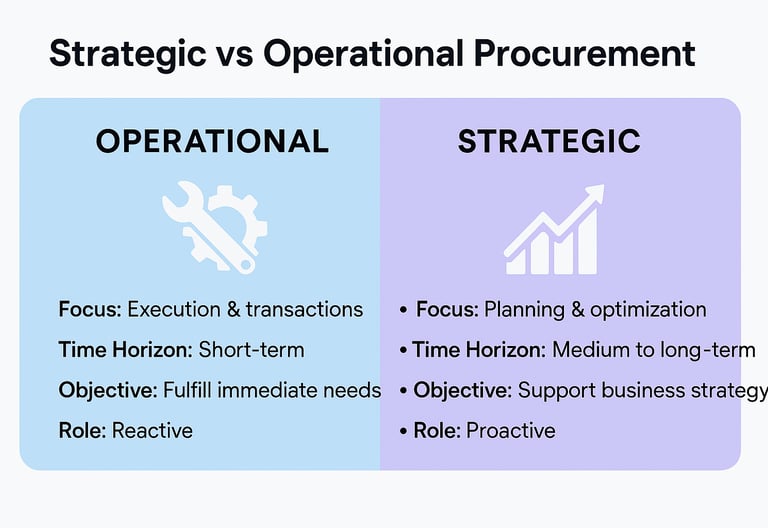
In the fast-evolving world of supply chain and purchasing, understanding the distinction between strategic procurement and operational procurement is essential for building efficient, cost-effective, and future-ready organizations.
Whether you're a procurement professional, a business owner, or just entering the field, knowing how these two approaches differ—and how they complement each other—can give you a strong competitive edge.
🔍 What is Operational Procurement?
Operational procurement refers to the day-to-day processes involved in acquiring goods and services needed for a company to run smoothly. It’s the engine room of purchasing—practical, process-driven, and essential for maintaining workflows.
✅ Key Characteristics:
Short-term focus
Transactional tasks
Ensures stock availability and continuity
Involves POs, invoices, deliveries, and returns
💡 Example:
Ordering office supplies, raw materials, or spare parts for machinery falls under operational procurement. It's about executing approved purchases efficiently and on time.
📈 What is Strategic Procurement?
Strategic procurement (also called strategic sourcing) takes a long-term, value-driven approach. It focuses on aligning purchasing decisions with company goals, optimizing supplier relationships, and reducing overall costs—not just the purchase price.
✅ Key Characteristics:
Long-term planning
Value creation over time
Supplier collaboration and innovation
Market analysis, risk mitigation, contract negotiation
💡 Example:
Negotiating a 3-year agreement with a key supplier that includes price stability, sustainability goals, and joint development of new materials.
⚖️ Key Differences Between Strategic and Operational Procurement
Aspect Operational Procurement Strategic Procurement
Focus Immediate needs Long-term value
Timeframe Short-term Medium to long-term
Goal Efficient purchasing Cost reduction, risk control
Approach Reactive Proactive
Typical Tools ERP systems Spend analysis, SRM tools
Impact Operational efficiency Competitive advantage
🤝 Why You Need Both
Smart companies don’t choose either/or—they implement both.
Operational procurement ensures daily business continuity, while strategic procurement enables sustainable growth, risk management, and innovation. When combined, they create a procurement function that is both agile and resilient.
🧠 Pro Tip for Procurement Managers
To stay competitive:
Automate operational tasks with procurement software
Invest time in supplier development and strategic planning
Use spend analytics to identify hidden savings opportunities
📢 Final Thoughts
The difference between operational and strategic procurement isn't just academic—it’s transformational for your business. Organizations that fail to build strategic capabilities often find themselves stuck in reactive cycles, while market leaders invest in strategic sourcing to future-proof their operations.
Whether you’re streamlining operations or elevating procurement into a key driver of business growth, it all starts with understanding these two pillars.
🚀 Ready to Elevate Your Procurement Game?
Download our free Procurement Starter Kit to learn:
How to set up efficient operational workflows
How to build a strategic sourcing plan from scratch
Tools and templates to get started fast
FFM TRADE e.U.
Hadikgasse 64, 1140 Vienna, Austria
REQUEST A CONTACT:
info [at] ffmtrade.eu
+43 660 682 70 75
© 2026. FFM TRADE e.U. - All rights reserved.


D-U-N-S®-Number: 300829100