



Procurement in 2026: Why the Old Way of Buying is Finally Over
Sourcing Smart: How 2026 Will Redefine International Trade
Dan Solomon
12/15/20252 min read

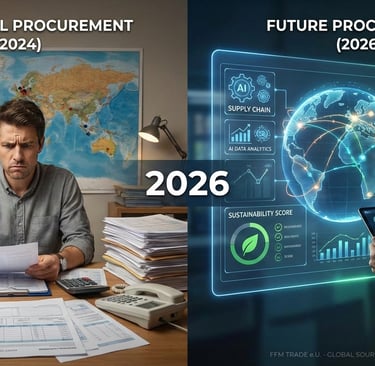
If the last few years have taught us anything in international trade, it is that "business as usual" is a dangerous strategy. As we look toward 2026, we are not just facing a new calendar year—we are staring at a fundamental shift in how goods are sourced, bought, and moved across borders.
At FFM Trade, we have navigated the waters of international commerce since 1991. We have seen trends come and go. But the changes approaching in 2026 are different. They aren't just about price; they are about transparency, technology, and resilience.
Here is what we see changing in the procurement landscape by 2026, and what it means for your business.
1. Sustainability Moves from "Nice-to-Have" to "License to Operate"
For decades, sustainability was often a marketing buzzword. By 2026, it will be a regulatory gatekeeper. With the tightening of EU regulations (such as the Supply Chain Due Diligence Directive and stricter carbon reporting), procurement teams can no longer just look at the price tag.
You will need to know the entire story of a product—from the raw material harvest to the factory floor.
· The Change: Procurement will require "Digital Product Passports" and verified data on CO2 emissions.
· Our Take: This aligns perfectly with our philosophy. "We trade FAIR" isn't just a slogan anymore; it’s the only way to ensure your goods don’t get stuck at customs in 2026.
2. The End of the "Just-in-Time" Obsession
The era of hyper-efficient, razor-thin inventory margins is ending. The global supply chain has proven too fragile for the "Just-in-Time" model to work flawlessly in a world of geopolitical friction and climate instability.
By 2026, the smartest procurement strategy will shift toward "Just-in-Case". This means:
· Diversifying supplier bases (avoiding reliance on a single region).
· Holding strategic buffer stock.
· Valuing reliability over the absolute lowest rock-bottom price.
3. AI Won't Replace Buyers, But It Will Remove the Guesswork
There is a lot of fear that AI will replace human relationships in trade. We disagree. In 2026, successful procurement will use AI as a "Co-Pilot," not an Autopilot.
Instead of spending hours on spreadsheets, procurement managers will use automated tools to:
· Predict price fluctuations in raw materials (like silk or cotton) before they happen.
· Automatically vet suppliers for compliance risks.
· The Result: This frees up humans to do what humans do best—building trust and negotiating complex partnerships.
4. The Rise of "Friend-Shoring"
Globalization is evolving into regionalization. By 2026, we expect to see a massive increase in "Friend-shoring"—sourcing from countries that share similar political and ethical standards. This reduces the risk of sudden trade wars or tariffs disrupting your supply chain overnight.
Summary: The 2026 Procurement Checklist
To thrive in this new environment, businesses must ask themselves three questions:
1. Visibility: Do I know my Tier-2 and Tier-3 suppliers?
2. Agility: Can I switch suppliers quickly if a crisis hits?
3. Compliance: Is my data ready for the new EU regulations?
At FFM Trade, we are already preparing for this future. Whether it is high-quality textiles or organic goods, we ensure our procurement processes are 2026-ready today, safeguarding your supply chain against tomorrow's risks.
FFM TRADE e.U.
Hadikgasse 64, 1140 Vienna, Austria
REQUEST A CONTACT:
info [at] ffmtrade.eu
+43 660 682 70 75
© 2026. FFM TRADE e.U. - All rights reserved.


D-U-N-S®-Number: 300829100